


FAQ
 10-14-2004, 07:17 AM
#1
Honda-Tech Member
Thread Starter

Join Date: Oct 2000
Location: Zoo York
Posts: 4,534
Likes: 0
Received 0 Likes
on
0 Posts
 FAQ
FAQ
This post will be a compilation of frequently asked questions (FAQ's) as well as a source of information. If you feel something should be added, PM either myself or Doctor Cortez and we'll be sure to add it. Keep in mind this is just the beginning.
Plasma Cutter
A plasma cutter can pass through metals with little or no resistance thanks to the unique properties of plasma. So what is plasma?
There are four states of matter in the world. Most things we deal with in our daily lives are in the form of solids, liquids, or gases. These states are divided based on the way that molecules behave within each one. Take water as an example:
As a solid, water takes the form of ice. Ice is made up of neutrally charged atoms arranged in a hexagonal pattern that forms a solid. Because the molecules stay fairly still relative to each other, they form a solid -- something that holds its shape.
As a liquid, water takes its drinkable form. The molecules are still bound to each other, but they move relative to each other at slow speeds. The liquid has a fixed volume, but no constant shape. It changes shape to fit whatever container you put it in.
As a gas, water takes the form of steam. In steam, molecules move around at high speeds, independently of each other. Because the molecules are not bound to each other, a gas has no fixed shape or fixed volume.
The amount of heat (which translates to the amount of energy) applied to water molecules determines their behavior and therefore their state. Simply put, more heat (more energy) excites molecules to the point that they break free of bonds that bind them together. With minimal heat, the molecules are tightly bound, and you get a solid. With more heat, the molecules escape the rigid bonds, and you get a liquid. With even more heat, the molecules escape the loose bonds, and you get a gas.
If you boost a gas to extremely high temperatures, you get plasma. The energy begins to break apart the gas molecules, and the atoms begin to split. Normal atoms are made up of protons and neutrons in the nucleus (see How Atoms Work), surrounded by a cloud of electrons. In plasma, the electrons separate from the nucleus. Once the energy of heat releases the electrons from the atom, the electrons begin to move around quickly. The electrons are negatively charged, and they leave behind their positively charged nuclei. These positively charged nuclei are known as ions.
When the fast-moving electrons collide with other electrons and ions, they release vast amounts of energy. This energy is what gives plasma its unique status and unbelievable cutting power. (howstuffworks.com)
Plasma Cutter
A plasma cutter can pass through metals with little or no resistance thanks to the unique properties of plasma. So what is plasma?
There are four states of matter in the world. Most things we deal with in our daily lives are in the form of solids, liquids, or gases. These states are divided based on the way that molecules behave within each one. Take water as an example:
As a solid, water takes the form of ice. Ice is made up of neutrally charged atoms arranged in a hexagonal pattern that forms a solid. Because the molecules stay fairly still relative to each other, they form a solid -- something that holds its shape.
As a liquid, water takes its drinkable form. The molecules are still bound to each other, but they move relative to each other at slow speeds. The liquid has a fixed volume, but no constant shape. It changes shape to fit whatever container you put it in.
As a gas, water takes the form of steam. In steam, molecules move around at high speeds, independently of each other. Because the molecules are not bound to each other, a gas has no fixed shape or fixed volume.
The amount of heat (which translates to the amount of energy) applied to water molecules determines their behavior and therefore their state. Simply put, more heat (more energy) excites molecules to the point that they break free of bonds that bind them together. With minimal heat, the molecules are tightly bound, and you get a solid. With more heat, the molecules escape the rigid bonds, and you get a liquid. With even more heat, the molecules escape the loose bonds, and you get a gas.
If you boost a gas to extremely high temperatures, you get plasma. The energy begins to break apart the gas molecules, and the atoms begin to split. Normal atoms are made up of protons and neutrons in the nucleus (see How Atoms Work), surrounded by a cloud of electrons. In plasma, the electrons separate from the nucleus. Once the energy of heat releases the electrons from the atom, the electrons begin to move around quickly. The electrons are negatively charged, and they leave behind their positively charged nuclei. These positively charged nuclei are known as ions.
When the fast-moving electrons collide with other electrons and ions, they release vast amounts of energy. This energy is what gives plasma its unique status and unbelievable cutting power. (howstuffworks.com)
 10-14-2004, 08:35 AM
#2
Honda-Tech Member

Join Date: Nov 2001
Location: ...
Posts: 6,400
Likes: 0
Received 0 Likes
on
0 Posts
Re: FAQ (ek9t)
Mig vs Tig...
The TIG (Tungsten Inert Gas) welding process (also known as gas tungsten arc welding, GTAW, or HELIARC, a trade name of Linde) generates heat from an electric arc maintained between a non consumable tungsten electrode and the part being welded. This process was developed for the aircraft industry back in the early '40s. TIG may be used without the addition of a filler metal or a separate wire filler metal can be added into the puddle when additional material is required, much like the process in oxy-acetylene welding. The puddle, the tungsten electrode and the filler rod are protected from atmosphere by a shield of inert gas to prevent rapid oxidation of the weld and surrounding metal. Argon is the most widely utilized gas. Because the gas shield does not produce the slag that normally is created by flux, the danger of slag inclusion in the weld metal is eliminated. Also, due to the slow speed of the TIG process, gases and other impurities escape to the surface of the puddle before solidification occurs, eliminating pockets called "Porosity" common in weld processes that employ gas shielding but have greater travel speeds than the TIG process. TIG also produces a welding heat is that is confined between the weld and base metal at the point of fusion and produces a narrow heat affected zone. This reduces stress, cracking and distortion in the finished weld. Spatter is not produced by this process, leaving the weld and surrounding metal clean. Because of the lack of spatter and flux smoke, the TIG process allows the operator a clear view of the weld puddle. The torch body in most cases is small enough that the operator can hold it in the same manner as he would hold a pencil allowing easier manipulation. The power source is constant current, either AC, DC, or combination AC/DC. Type of metal determines which type is used. DC (direct current) is most normally used for TIG welding of stainless steels and mild and low alloy steels. AC (Alternating current) is used for TIG welding of aluminum. Surface oxidation is automatically removed by the action of the arc each time the electrode becomes positive, (60 times per. second). Because AC crosses over the zero volt point 120 times per second (once going positive and once going negative each cycle), the arc shuts off 120 times per second. To keep the arc going when using AC, a high frequency "arc stabilizer" is used. The high frequency also allows the start of an arc in DC mode without having to "strike" an arc, thereby reducing the possibility of tungsten contamination. If the electrode accidentally touches the weld pool, it becomes contaminated and must be cleaned immediately to prevent weld contamination. TIG requires an extremely clean surface to weld successfully and is a fairly slow operation. On the plus side, TIG produces high quality work and does not generate slag or spatter. The welder can adjust the heat input while welding by using foot or hand amperage controls.
MIG (Metal Inert Gas), also referred to as wire feed welding, utilizes a consumable arc. The process generates heat from an electric arc maintained between a consumable wire feed electrode and the part being welded. This process produces spatter making it difficult for the operator to see the weld and causing damage to nearby surfaces and objects from the hot particles thrown off. Flux cored "gasless" welders produce smoke from the flux, and pose a cleanup problem. Because of the higher welding speeds of the MIG process, the chance of producing porosity is higher. A common mistake with novice welders utilizing the MIG process is the possibility of producing a good looking weld with little penetration. A MIG can produce an arc into the puddle, allowing one to create a nice looking weld while the base metal underneath is not being properly melted. This cannot be detected before failure without either destructive or non-destructive testing. In the TIG process, the base metal is melted to produce a puddle before any filler is introduced into the weld. This allows the operator to see the penetration during the welding process. Another drawback in MIG welding in restoration of automobiles is the workability of the weld. The wire used in MIG cools harder than in TIG welding, making it harder to hammer and dolly the weld afterwards. Because MIG welding uses a constant fed wire to produce the arc, some buildup of material usually occurs that has to be ground off. This also generates heat in the panel that can cause warpage. With TIG, filler is only added when needed, and the thickness of the filler can be changed by picking up a different size rod. This reduces post weld finishing. While TIG welding requires greater skill, the results are far better than other welding methods. Welders of both types are available from many sources, such as Eastwood, Daytona Mig, and Professional sources such as Miller Electric. A source that I have found to be particularly helpful and has excellent prices is RRAM Sales. If you are looking for a welder, I recommend staying away from Flux cored units. They are messy and many do not have the power required to do most welding you will get into. Small 110 volt welders are available that will do a good job with practice, but go with gas for MIG (MIG by definition is metal INERT GAS, not flux) Flux cored units are advertised as "wire feed", Don't assume that they are MIG welders. If you are looking for a TIG, there are also several nice small units available, but consider it only if it has "high frequency" and AC if you don't want to mess with striking an arc and there is a remote possibility that you may want to weld Aluminum someday.
SAFETY NOTICE
Be careful when welding parts that are possibly plated! Welding of these materials is not for the average person, as special precautions must be taken! TOXIC FUMEScan be given off when welding various platings that can cause serious medical problems orDEATH. For an update of this problem and to visit a company interested in your safety, see Borgeson Universal Co. Any welding of suspension, steering, or safety critical component should be done by a qualified welder. Any weld that could cause an accident if it failed should be inspected by non-destructive means. Most local machine shops can perform magnaflux inspections at a reasonable price. Don't take chances - if in doubt, ask a professional.
The TIG (Tungsten Inert Gas) welding process (also known as gas tungsten arc welding, GTAW, or HELIARC, a trade name of Linde) generates heat from an electric arc maintained between a non consumable tungsten electrode and the part being welded. This process was developed for the aircraft industry back in the early '40s. TIG may be used without the addition of a filler metal or a separate wire filler metal can be added into the puddle when additional material is required, much like the process in oxy-acetylene welding. The puddle, the tungsten electrode and the filler rod are protected from atmosphere by a shield of inert gas to prevent rapid oxidation of the weld and surrounding metal. Argon is the most widely utilized gas. Because the gas shield does not produce the slag that normally is created by flux, the danger of slag inclusion in the weld metal is eliminated. Also, due to the slow speed of the TIG process, gases and other impurities escape to the surface of the puddle before solidification occurs, eliminating pockets called "Porosity" common in weld processes that employ gas shielding but have greater travel speeds than the TIG process. TIG also produces a welding heat is that is confined between the weld and base metal at the point of fusion and produces a narrow heat affected zone. This reduces stress, cracking and distortion in the finished weld. Spatter is not produced by this process, leaving the weld and surrounding metal clean. Because of the lack of spatter and flux smoke, the TIG process allows the operator a clear view of the weld puddle. The torch body in most cases is small enough that the operator can hold it in the same manner as he would hold a pencil allowing easier manipulation. The power source is constant current, either AC, DC, or combination AC/DC. Type of metal determines which type is used. DC (direct current) is most normally used for TIG welding of stainless steels and mild and low alloy steels. AC (Alternating current) is used for TIG welding of aluminum. Surface oxidation is automatically removed by the action of the arc each time the electrode becomes positive, (60 times per. second). Because AC crosses over the zero volt point 120 times per second (once going positive and once going negative each cycle), the arc shuts off 120 times per second. To keep the arc going when using AC, a high frequency "arc stabilizer" is used. The high frequency also allows the start of an arc in DC mode without having to "strike" an arc, thereby reducing the possibility of tungsten contamination. If the electrode accidentally touches the weld pool, it becomes contaminated and must be cleaned immediately to prevent weld contamination. TIG requires an extremely clean surface to weld successfully and is a fairly slow operation. On the plus side, TIG produces high quality work and does not generate slag or spatter. The welder can adjust the heat input while welding by using foot or hand amperage controls.
MIG (Metal Inert Gas), also referred to as wire feed welding, utilizes a consumable arc. The process generates heat from an electric arc maintained between a consumable wire feed electrode and the part being welded. This process produces spatter making it difficult for the operator to see the weld and causing damage to nearby surfaces and objects from the hot particles thrown off. Flux cored "gasless" welders produce smoke from the flux, and pose a cleanup problem. Because of the higher welding speeds of the MIG process, the chance of producing porosity is higher. A common mistake with novice welders utilizing the MIG process is the possibility of producing a good looking weld with little penetration. A MIG can produce an arc into the puddle, allowing one to create a nice looking weld while the base metal underneath is not being properly melted. This cannot be detected before failure without either destructive or non-destructive testing. In the TIG process, the base metal is melted to produce a puddle before any filler is introduced into the weld. This allows the operator to see the penetration during the welding process. Another drawback in MIG welding in restoration of automobiles is the workability of the weld. The wire used in MIG cools harder than in TIG welding, making it harder to hammer and dolly the weld afterwards. Because MIG welding uses a constant fed wire to produce the arc, some buildup of material usually occurs that has to be ground off. This also generates heat in the panel that can cause warpage. With TIG, filler is only added when needed, and the thickness of the filler can be changed by picking up a different size rod. This reduces post weld finishing. While TIG welding requires greater skill, the results are far better than other welding methods. Welders of both types are available from many sources, such as Eastwood, Daytona Mig, and Professional sources such as Miller Electric. A source that I have found to be particularly helpful and has excellent prices is RRAM Sales. If you are looking for a welder, I recommend staying away from Flux cored units. They are messy and many do not have the power required to do most welding you will get into. Small 110 volt welders are available that will do a good job with practice, but go with gas for MIG (MIG by definition is metal INERT GAS, not flux) Flux cored units are advertised as "wire feed", Don't assume that they are MIG welders. If you are looking for a TIG, there are also several nice small units available, but consider it only if it has "high frequency" and AC if you don't want to mess with striking an arc and there is a remote possibility that you may want to weld Aluminum someday.
SAFETY NOTICE
Be careful when welding parts that are possibly plated! Welding of these materials is not for the average person, as special precautions must be taken! TOXIC FUMEScan be given off when welding various platings that can cause serious medical problems orDEATH. For an update of this problem and to visit a company interested in your safety, see Borgeson Universal Co. Any welding of suspension, steering, or safety critical component should be done by a qualified welder. Any weld that could cause an accident if it failed should be inspected by non-destructive means. Most local machine shops can perform magnaflux inspections at a reasonable price. Don't take chances - if in doubt, ask a professional.
11-17-2004, 12:49 PM
#3
Honda-Tech Member
Join Date: Nov 2001
Location: ...
Posts: 6,400
Likes: 0
Received 0 Likes
on
0 Posts
Re: FAQ (Doctor CorteZ)
CARBON FIBRE
Carbon fibre is the most technological material available. It consists of a fabric of fibres immersed in a resin and then solidified. Mechanically, it can be unbeatable.
It is a synthetic fabric made up of fibres derived from petroleum and processed at high temperature. Advanced composite materials in carbon fibre are obtained by combining two or more components. Of all existing composite materials, the fibrous ones have the highest structural properties.
The unidirectional or woven fibres, pre-impregnated in resin, are placed in moulds along the load lines indicated by mathematical calculations, so as to obtain a component which meets specific technical and structural requirements. The process is completed with the hardening of the resin, which is achieved by “baking” in an autoclave to produce the final solid material.
Carbon fibre is a polymer which is a form of graphite. Graphite is one of the states of pure carbon. In graphite, the carbon atoms are disposed in aromatic hexagonal rings bonded to each other to form large planes. Their appearance is like that of metal netting.
Carbon fibres are a form of graphite in which these sheets are long and narrow; imagine that they are ribbons of graphite. These ribbons group together readily in bundles to form fibres, hence the name carbon fibre.
The fibres are not normally used alone, but are used to reinforce materials such as epoxy resins or other thermosetting materials. The resulting reinforced materials are known as composites because they contain more than one component.
Composites reinforced with carbon fibre have a very favourable strength to weight ratio. They are often stronger than steel but much lighter. For this reason, they are used to replace metals in many applications, such as aircraft, the Space Shuttle, race car bodies, tennis rackets and golf clubs.
"Carbon fibre" is a composite material in which the carbon fibre constitutes the effective reinforcement, enclosed in polymer resins of different types. The fibre performs the work of resisting stresses, while the resins act as a binding agent, i.e. they keep the fibres in their original position. This is because, while traditional metals respond identically to stresses applied in different directions, carbon fibre only resists stresses applied along the length of the fibres. It therefore follows that the right direction of the fibres is the cornerstone of a correctly built carbon chassis, which means that technology and experience are primary considerations.
It is true that carbon can be used to make all kinds of items. It is even used to make fishing rods and tennis rackets. But the chassis and suspension arms of Formula 1 cars are also made of carbon fibre, and for these applications you can't be casual with regard to strength and solidity. Everything depends on how the carbon is processed. The carbon thread itself has identical properties in every fibre, but it is woven differently so as to ensure adequate strength according to the direction of application of the stress. The secret of carbon fibre lies in the layering of its "skins": each layer can have different properties and is disposed along the stress lines to which the finished product will be subject.
Technique, creativity and precision are essential requirements for producing a hi-tech chassis. Along the entire path from idea to finished product, our chief pre-occupation is to strike the ideal balance between strength and weight.
To achieve our goal, we have developed a system of processing which makes best use of all the advantages of carbon fibre. The products made using these fabrics, impregnated with epoxy resins, bind the carbon atoms, and incorporate incredibly high strength and elasticity.
A monocoque structure in carbon fibre is currently the best material available for the construction of chassis, thanks to its high strength and low weight.
Properties:
• High specific strength
• High tensile strength
• High specific modulus of elasticity
• Low weight
Carbon fibre is the most technological material available. It consists of a fabric of fibres immersed in a resin and then solidified. Mechanically, it can be unbeatable.
It is a synthetic fabric made up of fibres derived from petroleum and processed at high temperature. Advanced composite materials in carbon fibre are obtained by combining two or more components. Of all existing composite materials, the fibrous ones have the highest structural properties.
The unidirectional or woven fibres, pre-impregnated in resin, are placed in moulds along the load lines indicated by mathematical calculations, so as to obtain a component which meets specific technical and structural requirements. The process is completed with the hardening of the resin, which is achieved by “baking” in an autoclave to produce the final solid material.
Carbon fibre is a polymer which is a form of graphite. Graphite is one of the states of pure carbon. In graphite, the carbon atoms are disposed in aromatic hexagonal rings bonded to each other to form large planes. Their appearance is like that of metal netting.
Carbon fibres are a form of graphite in which these sheets are long and narrow; imagine that they are ribbons of graphite. These ribbons group together readily in bundles to form fibres, hence the name carbon fibre.
The fibres are not normally used alone, but are used to reinforce materials such as epoxy resins or other thermosetting materials. The resulting reinforced materials are known as composites because they contain more than one component.
Composites reinforced with carbon fibre have a very favourable strength to weight ratio. They are often stronger than steel but much lighter. For this reason, they are used to replace metals in many applications, such as aircraft, the Space Shuttle, race car bodies, tennis rackets and golf clubs.
"Carbon fibre" is a composite material in which the carbon fibre constitutes the effective reinforcement, enclosed in polymer resins of different types. The fibre performs the work of resisting stresses, while the resins act as a binding agent, i.e. they keep the fibres in their original position. This is because, while traditional metals respond identically to stresses applied in different directions, carbon fibre only resists stresses applied along the length of the fibres. It therefore follows that the right direction of the fibres is the cornerstone of a correctly built carbon chassis, which means that technology and experience are primary considerations.
It is true that carbon can be used to make all kinds of items. It is even used to make fishing rods and tennis rackets. But the chassis and suspension arms of Formula 1 cars are also made of carbon fibre, and for these applications you can't be casual with regard to strength and solidity. Everything depends on how the carbon is processed. The carbon thread itself has identical properties in every fibre, but it is woven differently so as to ensure adequate strength according to the direction of application of the stress. The secret of carbon fibre lies in the layering of its "skins": each layer can have different properties and is disposed along the stress lines to which the finished product will be subject.
Technique, creativity and precision are essential requirements for producing a hi-tech chassis. Along the entire path from idea to finished product, our chief pre-occupation is to strike the ideal balance between strength and weight.
To achieve our goal, we have developed a system of processing which makes best use of all the advantages of carbon fibre. The products made using these fabrics, impregnated with epoxy resins, bind the carbon atoms, and incorporate incredibly high strength and elasticity.
A monocoque structure in carbon fibre is currently the best material available for the construction of chassis, thanks to its high strength and low weight.
Properties:
• High specific strength
• High tensile strength
• High specific modulus of elasticity
• Low weight
 11-23-2004, 07:23 AM
#5
Honda-Tech Member
Join Date: Nov 2001
Location: ...
Posts: 6,400
Likes: 0
Received 0 Likes
on
0 Posts
04-19-2006, 06:19 PM
#6
Honda-Tech Member

Join Date: May 2003
Location: kzoo, small town mi, usa
Posts: 2,830
Likes: 0
Received 0 Likes
on
0 Posts
weld info
There has been a lot of confusion i think in what welding is, and what the do's and dont's are to welding in general. A lot of people wanting to get started, make there own stuff ect.. and need a little guidance into welding. This is only my opinion, and stuff that i have learned thru out the past couple of years as i work towards my welding engineering degree. ok lets get started.
Mig welding: Also known as gmaw or gas metal arc welding. An arc created between a continiously fed filler metal and and the weld pool. either has an externally supplied shielding gas with or without pressure
*Uses heat of the continuosly fed electrode and the work piece
*Arc melts the base metal
*The melted filler material is deposited into the weld pool
*An external shielding gas must be supplied (usually a co2 argon mix)
*Gas can be active co2 or argon base wich is considered and inert gas
*inert gas: a gas that does not change no matter what the conditions in heat.
Types of transfer for the gmaw process:
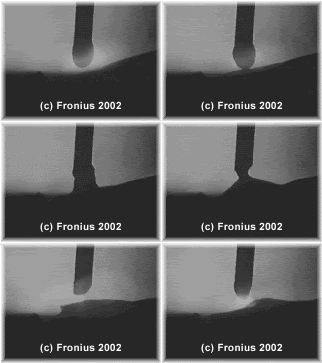
*Short circuit: This is the most common type of transfer. Uses .023-.045 dia wire. Fast frrezing puddle with minimal distortion. Metal only transfers when contact is made between the base metal and the filler metal. Happens at the lowest welding current and volts 14-23 v and 100-270 amps. Sounds like crackling bacon when you are welding.
This is what it looks like.
Equiptment needed:
Power source- Constant voltage, variable amperage direct current.
Wire feeder-Deliver filler metal at a constant speed to the puddle. Controls gas flow.
Welding gun (torch)-Carries electrode from feeder to the weld pool. Also delivers gas and the electical power to the weld zone.
Gas supply-Inert or active shielding gas with a regulator or flow meter.
Wire supply-This is determined on the process that you are doing, and should be consulted with your local welding dude that know's what he is doin.
Globular transfer: This is the first transfer that came out. And is rarely to never used on here. It is exactly what it is. Glob's of **** on your metal.
*Higher voltages and wire feed speeds 22.5v-24v and 165-365 amps
*Metal starts to transfer thru the arc and forms into large droplets onto the metal.
*Produces heavy spatter and has a very unstable arc
Looks like this
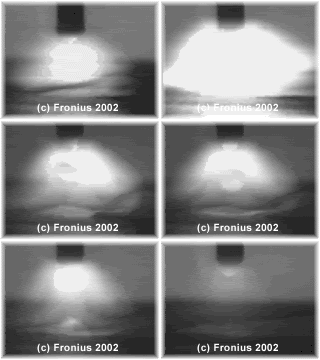
Spray arc transfer: Highest voltage and amps 24 volts and above with 135-500 amps
*Uses 5% to 10% co2 mis with argon or oxyegen.
*Forms very small droplets of metal
*Very good stability
*Very little spatter
*Limited on positions of applications tho.
*needs better equiptment to run this process.
looks like this.
Pulsed mig: Newest type of transfer.
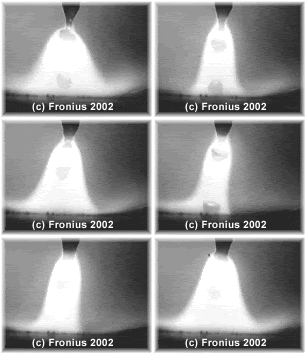
*Current switches between a high and a lower value
*Low value is below the transition point of the electrical cycle and there is no transfer fo metal in this stage.
*Higher value Is higher than spray arc transfer and this is where the transfer of metal happens.
*these cycles can happen between 60-3000 times per second.
*This also requires a special power source and is not really needed for the do it yourselfer, but if your on a production line, and you go from 50 lbs an hour with short circuit transfer, and you switch to a power source or transfer type that can produce you twice as much weld with better quality the investment is worth it.
The transfer looks like this.
Keep in mind this is all generalized, and people are coming out with such new stuff now days that the welding industry is almost changing as fast as computer technology. Such as millers new accupulse transfer that i just got to try out yesterday. It was amazing, and is a transfer between pulse spray and short circuit all in one. It is truely amazing.
Mig welding has also adopted some new types of filler metal into the welding family.
Metal cored wire: New filler metal family that combines the efficiency of solid gmaw wires and the productivity of flux cored wires.
Lower fume generation
95-98% efficiency rating
No slag
Reduced cold lapping
Improved sidewall fusion.
This is done in the spray transfer mode and provides litttle to no spatter whatsoever.
This wire is a tubular wire with metallic element filler in the inside of the wire to match different welding applications.
Concept of this: Nearly all electiral current travels thru the outter shell of the wire, while the metallic filler in the middle mixes in with the puddle so you can weld different alloyed metals. Gets better wider slightly shallower penetration profile.
Flux cored wires:An arc between an continuously fed filler metal and the weld pool. This process is used with a shielding contained in the tubular electrode and can be used with our without an externally supplied shielding gas depending on the wire you are using. A lot of the harbor freight cheepo welders use fluxcore.
You may see it like this. FCAW-SS=Self shielded
FCAW-GS=Gas shielded
The fluxing is contained on the inside of the wire, and the flux covers the metal after you weld it to protect the weld from the atmosphere causing porosity and such. Must be chipped off like a stick weld.
Filler metal reading. If you ever look at your filler metal you may see some different types of letters and numbers. Well these do mean something and here is what they mean.
For example.
E70t-10
Ok here is what goes down.
E=electrode
7=Tensile strength usually x's 10 or ksi
0= Flat or horizontal position filler metal if it was a 1 it is all positions
T=In this one it means it's a flux cored wire.
10=Indicates performance and usablility of the filler metal.
Modified by jaydmcrx at 10:52 PM 4/19/2006
Mig welding: Also known as gmaw or gas metal arc welding. An arc created between a continiously fed filler metal and and the weld pool. either has an externally supplied shielding gas with or without pressure
*Uses heat of the continuosly fed electrode and the work piece
*Arc melts the base metal
*The melted filler material is deposited into the weld pool
*An external shielding gas must be supplied (usually a co2 argon mix)
*Gas can be active co2 or argon base wich is considered and inert gas
*inert gas: a gas that does not change no matter what the conditions in heat.
Types of transfer for the gmaw process:
*Short circuit: This is the most common type of transfer. Uses .023-.045 dia wire. Fast frrezing puddle with minimal distortion. Metal only transfers when contact is made between the base metal and the filler metal. Happens at the lowest welding current and volts 14-23 v and 100-270 amps. Sounds like crackling bacon when you are welding.
This is what it looks like.
Equiptment needed:
Power source- Constant voltage, variable amperage direct current.
Wire feeder-Deliver filler metal at a constant speed to the puddle. Controls gas flow.
Welding gun (torch)-Carries electrode from feeder to the weld pool. Also delivers gas and the electical power to the weld zone.
Gas supply-Inert or active shielding gas with a regulator or flow meter.
Wire supply-This is determined on the process that you are doing, and should be consulted with your local welding dude that know's what he is doin.
Globular transfer: This is the first transfer that came out. And is rarely to never used on here. It is exactly what it is. Glob's of **** on your metal.
*Higher voltages and wire feed speeds 22.5v-24v and 165-365 amps
*Metal starts to transfer thru the arc and forms into large droplets onto the metal.
*Produces heavy spatter and has a very unstable arc
Looks like this
Spray arc transfer: Highest voltage and amps 24 volts and above with 135-500 amps
*Uses 5% to 10% co2 mis with argon or oxyegen.
*Forms very small droplets of metal
*Very good stability
*Very little spatter
*Limited on positions of applications tho.
*needs better equiptment to run this process.
looks like this.
Pulsed mig: Newest type of transfer.
*Current switches between a high and a lower value
*Low value is below the transition point of the electrical cycle and there is no transfer fo metal in this stage.
*Higher value Is higher than spray arc transfer and this is where the transfer of metal happens.
*these cycles can happen between 60-3000 times per second.
*This also requires a special power source and is not really needed for the do it yourselfer, but if your on a production line, and you go from 50 lbs an hour with short circuit transfer, and you switch to a power source or transfer type that can produce you twice as much weld with better quality the investment is worth it.
The transfer looks like this.
Keep in mind this is all generalized, and people are coming out with such new stuff now days that the welding industry is almost changing as fast as computer technology. Such as millers new accupulse transfer that i just got to try out yesterday. It was amazing, and is a transfer between pulse spray and short circuit all in one. It is truely amazing.
Mig welding has also adopted some new types of filler metal into the welding family.
Metal cored wire: New filler metal family that combines the efficiency of solid gmaw wires and the productivity of flux cored wires.
Lower fume generation
95-98% efficiency rating
No slag
Reduced cold lapping
Improved sidewall fusion.
This is done in the spray transfer mode and provides litttle to no spatter whatsoever.
This wire is a tubular wire with metallic element filler in the inside of the wire to match different welding applications.
Concept of this: Nearly all electiral current travels thru the outter shell of the wire, while the metallic filler in the middle mixes in with the puddle so you can weld different alloyed metals. Gets better wider slightly shallower penetration profile.
Flux cored wires:An arc between an continuously fed filler metal and the weld pool. This process is used with a shielding contained in the tubular electrode and can be used with our without an externally supplied shielding gas depending on the wire you are using. A lot of the harbor freight cheepo welders use fluxcore.
You may see it like this. FCAW-SS=Self shielded
FCAW-GS=Gas shielded
The fluxing is contained on the inside of the wire, and the flux covers the metal after you weld it to protect the weld from the atmosphere causing porosity and such. Must be chipped off like a stick weld.
Filler metal reading. If you ever look at your filler metal you may see some different types of letters and numbers. Well these do mean something and here is what they mean.
For example.
E70t-10
Ok here is what goes down.
E=electrode
7=Tensile strength usually x's 10 or ksi
0= Flat or horizontal position filler metal if it was a 1 it is all positions
T=In this one it means it's a flux cored wire.
10=Indicates performance and usablility of the filler metal.
Modified by jaydmcrx at 10:52 PM 4/19/2006
04-19-2006, 07:04 PM
#7
Honda-Tech Member
Join Date: May 2003
Location: kzoo, small town mi, usa
Posts: 2,830
Likes: 0
Received 0 Likes
on
0 Posts
Re: weld info (jaydmcrx)
Tig welding: Also known as GTAW or gas tungsten arc welding.
A welding process which joins metals by heating them with a non consumable tungsten electrode with a With a shielding gas that is externally supplied inert gas. Either argon or inert gas mixes.
*Welds more types of metal (for now)
*Can weld disimmilar metals
*Filler metals can be added seperatly'
*Temps of up to 35,000 deg's F
This provides a highly concentrated welding arc and a pin point haz or heat affected zone if done right. There is no flux or slag, no sparks or spatter, and creates little noise smoke, or fumes.
The downside is low deposition rate and requires the highest level of skill of any welding process.
This is the process that you see come out of welds like this.
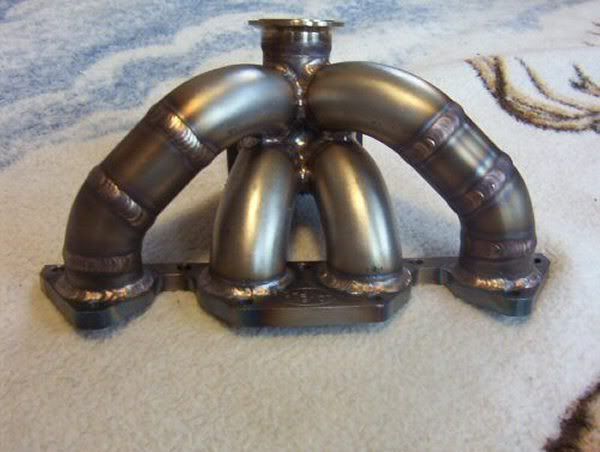
I hope cody doesn't mind me stealing one of his pics. He is a very very very good welder. I have seen him in person, and all i can say quality!
To be honest with you, This is the the true craftsman type of welding. But From what i have been seeing going to miller demo's and lincoln demo's they are coming out with power source technology that is very very fast, and very very good getting as good or if not better weld quality from the pulsed mig process. With stainless, and aluminum. They even have programs on some of the new machines coming out that you can weld exotic metals with, and the best part about a lot of the machines is that they have upgradable software. So when they come out with a new metal that you want to weld on, they can program the welder to do so. It is pretty amazing and can all be done with a palm pilot and a media cord.
I don't see this process going anywhere ever, but i think it will change the quality standards of american manufacturing yet again.
A welding process which joins metals by heating them with a non consumable tungsten electrode with a With a shielding gas that is externally supplied inert gas. Either argon or inert gas mixes.
*Welds more types of metal (for now)
*Can weld disimmilar metals
*Filler metals can be added seperatly'
*Temps of up to 35,000 deg's F
This provides a highly concentrated welding arc and a pin point haz or heat affected zone if done right. There is no flux or slag, no sparks or spatter, and creates little noise smoke, or fumes.
The downside is low deposition rate and requires the highest level of skill of any welding process.
This is the process that you see come out of welds like this.
I hope cody doesn't mind me stealing one of his pics. He is a very very very good welder. I have seen him in person, and all i can say quality!
To be honest with you, This is the the true craftsman type of welding. But From what i have been seeing going to miller demo's and lincoln demo's they are coming out with power source technology that is very very fast, and very very good getting as good or if not better weld quality from the pulsed mig process. With stainless, and aluminum. They even have programs on some of the new machines coming out that you can weld exotic metals with, and the best part about a lot of the machines is that they have upgradable software. So when they come out with a new metal that you want to weld on, they can program the welder to do so. It is pretty amazing and can all be done with a palm pilot and a media cord.
I don't see this process going anywhere ever, but i think it will change the quality standards of american manufacturing yet again.
Trending Topics
04-19-2006, 07:19 PM
#8
Honda-Tech Member
Join Date: May 2003
Location: kzoo, small town mi, usa
Posts: 2,830
Likes: 0
Received 0 Likes
on
0 Posts
Re: weld info (jaydmcrx)
Ok as far as tig welding aluminum. I left this one for last for now. I don't feel like typing too much anymore, so i will therefore keep this brief. You just can't go out and weld with any ol filler metal on any ol aluminum you feel like.
Aluminum is great for many applications
It has Great ductility.
Light weight
resists corrosion
Non sparking
Non toxic
Good electrical conductivity
good thermal conductivity.
Designation of alloy groups
1xxx Pure copper 99% and greater Must be welded with a 1000 series filler metal. Not heat treatable.
2xxx copper (not weldable) Considered mostly not weldable. Heat treatable.
3xxx Manganese Used largely for castings, must match filler material exactly. Not heat treatable.
4xxx silicone Weldable. Not heat treatable.
5xxx magnesium Weldable. Not heat treatable.
6xxx Magnesium and silicone Weldable, But may need heat treating. Heat treatable.
7xxx Zinc Not weldable. Heat treatable.
8xxx other elements Weldable on alloy or heat treat.
1xxx,3xxx,4xxx,5xxx alloys gain strength from cold working, and can be welded with out without filler metal.
2xxx,6xxx,7xxx series aluminums use heat treating for strength, and if they are weldable they must have matched filler metal in order to prevent cracking when welding.
Anyone can feel free to add info on here. I am but one person learning as i go along. The best part about this is you can learn anything from anyone at anytime. I hope that someone can look at this and see what they need to do or how to fix there problem in the future.
Aluminum is great for many applications
It has Great ductility.
Light weight
resists corrosion
Non sparking
Non toxic
Good electrical conductivity
good thermal conductivity.
Designation of alloy groups
1xxx Pure copper 99% and greater Must be welded with a 1000 series filler metal. Not heat treatable.
2xxx copper (not weldable) Considered mostly not weldable. Heat treatable.
3xxx Manganese Used largely for castings, must match filler material exactly. Not heat treatable.
4xxx silicone Weldable. Not heat treatable.
5xxx magnesium Weldable. Not heat treatable.
6xxx Magnesium and silicone Weldable, But may need heat treating. Heat treatable.
7xxx Zinc Not weldable. Heat treatable.
8xxx other elements Weldable on alloy or heat treat.
1xxx,3xxx,4xxx,5xxx alloys gain strength from cold working, and can be welded with out without filler metal.
2xxx,6xxx,7xxx series aluminums use heat treating for strength, and if they are weldable they must have matched filler metal in order to prevent cracking when welding.
Anyone can feel free to add info on here. I am but one person learning as i go along. The best part about this is you can learn anything from anyone at anytime. I hope that someone can look at this and see what they need to do or how to fix there problem in the future.
 this is sticky material
  04-20-2006, 06:37 PM
#12
Honda-Tech Member
Join Date: May 2003
Location: kzoo, small town mi, usa
Posts: 2,830
Likes: 0
Received 0 Likes
on
0 Posts
Re: weld info (thermal)
Yah my fingers got kinda sore, but i think that if it can help someone thru a problem, or begin to make something easier it was worth it. Great info, and if you have any questions i can try and answer them the best i can. 


 04-21-2006, 05:33 AM
#17
Member

Join Date: Jun 2003
Location: Somewhere in the lower part of, MI, U.S.A
Posts: 2,262
Likes: 0
Received 0 Likes
on
0 Posts
Re: weld info (jaydmcrx)
on that manifold at least it looks like cody did a ))))) type of movement... some people go /\/\/\/\ etc... everyone has their own way they are comforible with, i personally like to do almost like tirangles when i'm filling gaps like that


 12-26-2007, 10:53 PM
#23

Join Date: Nov 2007
Location: Manhattan, KS, USA
Posts: 11
Likes: 0
Received 0 Likes
on
0 Posts
Re: (k24em2)
it really depends. I'm just in school now for welding. At least I thought he said Argon Im not really sure haha. Mig is this up coming semester. So far we've only done oxy-acetylene and stick welding. Sorry If I got them confused. Before going into school for welding I had never welded in my life haha. Now I love it.
01-25-2008, 10:53 AM
#24
Honda-Tech Member

mig - steel pure c02, to c02 argon blends usually 75/25. aluminium pure argon.
tig - pure argon or helium. this is where the term heli-arc comes from.
stainless needs to be backpurged or use solar paste. otherwise you sacrifice weld strength and get the funk on the back of the metal. same thing with titanium.
tig - pure argon or helium. this is where the term heli-arc comes from.
stainless needs to be backpurged or use solar paste. otherwise you sacrifice weld strength and get the funk on the back of the metal. same thing with titanium.
02-02-2008, 05:23 PM
#25
Working
